


Strength Training for Beginners: Build Strength, Confidence, and Healthy Habits
- AarogyaSage

- Aug 11
- 10 min read
Strength training can feel confusing at first. There are machines, dumbbells, resistance bands, bodyweight exercises, and plenty of advice that sounds more advanced than useful. The good news is simple: beginners do not need a perfect programme. They need safe movement, steady practice, and a plan that can be repeated.
Strength training means using resistance to make muscles work harder than usual. That resistance can come from bodyweight, free weights, machines, resistance bands, or everyday objects used safely. Done well, it helps build muscle, protect joints, improve balance, support bone health, and make daily tasks easier.
The World Health Organization recommends adults do muscle-strengthening activities on two or more days per week, involving major muscle groups. That does not mean spending hours in a gym. A short, balanced routine done consistently can make a clear difference over time.
This guide covers the basics of strength training for beginners, including essential exercises, warm-ups, cool-downs, goal setting, and a simple weekly structure that works at home or in a gym.

What strength training does for the body
Strength training improves fitness in more ways than bigger muscles. It helps the body handle force better, which matters for walking upstairs, carrying groceries, picking up a child, getting off the floor, or sitting with better posture.
Some key benefits include:
Stronger muscles
Muscles adapt when they face a controlled challenge. Over time, the same movement feels easier.
Better bone support
Resistance exercise places healthy stress on bones. Research supports strength training as one habit that can help maintain bone density, especially when combined with good nutrition and regular movement.
Improved joint stability
Stronger muscles around joints can support better control. This is useful for knees, shoulders, hips, and the lower back.
Better balance and coordination
Exercises like squats, lunges, and step-ups train the body to control movement in real-life positions.
Support for metabolic health
Muscle tissue uses energy. Strength training, along with aerobic activity and balanced meals, can support healthy body composition and blood sugar control.
More confidence
Learning to lift safely changes the way people move through daily life. Strength is practical, measurable, and motivating.
A common beginner mistake is thinking every session must feel exhausting. It should not. Good training leaves enough energy to recover, practise again, and build the habit.
The basics every beginner should know
Before choosing exercises, it helps to understand a few simple training ideas.
Form comes before weight. A light weight with good technique is more useful than a heavy weight moved poorly. The body learns movement patterns through repetition, so the first few weeks should focus on control.
Start with full-body training. Beginners usually make steady progress with two or three full-body sessions per week. This gives each major muscle group regular practice without requiring long workouts.
Progress slowly. Strength improves when the body receives a little more challenge over time. That can mean more repetitions, slightly more weight, slower movement, or better range of motion.
Rest is part of training. Muscles adapt between sessions. Most beginners do well with at least one rest day between strength workouts for the same muscle groups.
Discomfort is not the same as pain. A working muscle may feel tired or warm. Sharp pain, joint pain, dizziness, or unusual discomfort is a sign to stop and reassess.
For people with a medical condition, recent injury, pregnancy, or long break from exercise, it is sensible to speak with a qualified health professional before starting. This article is for general information and is not medical advice.
Warm up before lifting
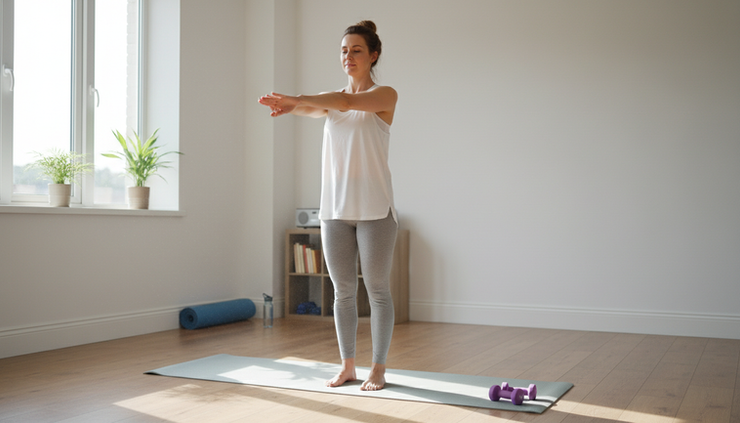
A warm-up prepares the body for movement. It raises body temperature, increases blood flow to working muscles, and gives joints a chance to move through comfortable ranges. It can also improve focus, which is important when learning technique.
A good beginner warm-up takes 5 to 10 minutes. It does not need to be complicated.
Try this simple sequence:
Easy movement for 3 minutes
March in place, walk around the room, use a stationary cycle, or climb stairs slowly.
Joint movement for 2 minutes
Do gentle shoulder circles, hip circles, ankle circles, and neck movements within a comfortable range.
Practice movements for 3 to 5 minutes
Do bodyweight squats, wall push-ups, light hip hinges, and arm reaches.
The goal is to feel warmer and more ready, not tired. If the workout includes squats, practise a few easy squats first. If it includes rows, practise pulling the shoulder blades back without weight. This teaches the body what is coming.
Essential strength exercises for beginners
A balanced session trains the main movement patterns: squat, hinge, push, pull, carry, and core control. These patterns cover most daily activities and build a strong base.
Bodyweight squat
The squat trains the thighs, hips, and core. It also improves the ability to sit down and stand up with control.
How to do it:
Stand with feet about hip to shoulder width apart.
Keep the chest lifted and ribs relaxed.
Bend the knees and hips together, as if sitting on a chair.
Keep heels on the floor.
Stand back up by pressing through the whole foot.
Start with 2 sets of 8 to 10 repetitions. If balance feels difficult, squat to a chair and stand back up.
Common form tip: Knees can move forward, but they should track in the same direction as the toes. Avoid letting them collapse inward.
Hip hinge
The hip hinge trains the back of the body, especially the hips and hamstrings. It is the pattern used in safe bending and lifting.
How to do it:
Stand tall with soft knees.
Place hands on the front of the hips.
Push the hips back while keeping the spine long.
Stop when a stretch is felt at the back of the thighs.
Return to standing by squeezing the hips forward.
Practise without weight first. Later, the same pattern can be used for a light weight lifted from the floor or held in front of the body.
Common form tip: The movement comes from the hips, not from rounding the lower back.
Wall push-up or elevated push-up
Push-ups train the chest, shoulders, arms, and core. A wall or kitchen counter version is often better for beginners than starting on the floor.
How to do it:
Place hands on a wall or stable raised surface.
Step back until the body forms a straight line.
Bend the elbows and bring the chest towards the surface.
Push away while keeping the body straight.
Start with 2 sets of 8 to 12 repetitions.
Common form tip: Keep elbows at a comfortable angle, not flared straight out to the sides.
Resistance band row or dumbbell row
Rows train the upper back and arms. They also help balance the pushing work done in push-ups.
How to do a band row:
Sit or stand tall.
Anchor the band securely at chest height, or loop it around the feet while seated.
Pull the band towards the body.
Squeeze the shoulder blades gently.
Return slowly.
Start with 2 sets of 10 to 12 repetitions.
Common form tip: Do not shrug the shoulders towards the ears. Keep the neck relaxed.
Glute bridge
The glute bridge trains the hips and supports lower-body strength.
How to do it:
Lie on the back with knees bent and feet flat.
Keep feet about hip width apart.
Press through the heels and lift the hips.
Pause briefly at the top.
Lower with control.
Start with 2 sets of 10 to 12 repetitions.
Common form tip: Stop when the body forms a straight line from shoulders to knees. Avoid arching the lower back.
Farmer carry
A carry builds grip, posture, and core strength. It also feels practical because it resembles carrying bags.
How to do it:
Hold a light weight in each hand.
Stand tall with shoulders relaxed.
Walk slowly for 20 to 30 seconds.
Keep breathing and avoid leaning to one side.
At home, two evenly loaded bags can work if they are safe to hold and not too heavy.
Common form tip: Walk tall. Do not rush.
Dead bug
The dead bug trains the core without needing sit-ups. It teaches the body to keep the trunk steady while arms and legs move.
How to do it:
Lie on the back with arms pointing up and knees bent.
Tighten the stomach gently, as if bracing before a cough.
Lower one heel towards the floor while lowering the opposite arm.
Return and switch sides.
Start with 2 sets of 6 to 8 repetitions per side.
Common form tip: Keep the lower back from arching away from the floor.
A simple beginner workout plan
A good beginner strength training workout should cover the whole body and leave room for practice. Start with two sessions per week for the first two to four weeks. Move to three sessions if recovery feels good.
Exercise | Sets | Repetitions or time | Main focus |
Bodyweight squat | 2 | 8 to 10 | Legs and hips |
Wall or elevated push-up | 2 | 8 to 12 | Chest, shoulders, arms |
Band row or dumbbell row | 2 | 10 to 12 | Upper back and arms |
Glute bridge | 2 | 10 to 12 | Hips |
Hip hinge practice | 2 | 8 to 10 | Hamstrings and lifting pattern |
Dead bug | 2 | 6 to 8 per side | Core control |
Farmer carry | 2 | 20 to 30 seconds | Grip, posture, core |
Rest for 60 to 90 seconds between sets. If breathing is still very heavy, rest a little longer.
A weekly plan can look like this:
Day | Plan |
Monday | Strength session |
Tuesday | Walk, mobility, or rest |
Wednesday | Rest or light activity |
Thursday | Strength session |
Friday | Walk, cycling, yoga, or rest |
Saturday | Optional easy activity |
Sunday | Rest |
After a few weeks, add a third session if the body feels ready. Keep at least one easier day between hard sessions.

How to choose the right weight
The right weight feels challenging but manageable. A simple test works well: at the end of a set, there should be about 2 to 3 good repetitions left in reserve. If form breaks down, the weight is too heavy or the set is too long.
For the first month, progress can come from better technique rather than heavier loads. Slower squats, smoother rows, and more controlled bridges are real progress.
Increase challenge in this order:
Improve form.
Add 1 or 2 repetitions per set.
Add one extra set.
Use a slightly heavier weight.
Slow down the lowering phase of the movement.
Make only one change at a time. This keeps training safe and makes progress easier to track.
Cool down after training
A cool-down helps the body shift from training to recovery. It can reduce the feeling of stiffness and gives breathing time to return to normal.
Spend 5 to 8 minutes on:
Slow walking or gentle marching
Deep, relaxed breathing
Easy stretching for the muscles trained
Gentle shoulder, hip, and back movements
Useful stretches include the chest stretch against a wall, seated hamstring stretch, child’s pose, and standing thigh stretch. Hold each stretch for around 20 to 30 seconds without bouncing.
Stretching should feel mild, not painful. The aim is to relax the body, not force extra range.
How to set achievable strength goals
Clear goals make training easier to follow. Beginners often set goals that are too vague, such as “get fit” or “tone up.” Better goals focus on behaviours and simple performance markers.
Examples of achievable goals:
Complete two strength sessions per week for one month.
Learn to squat to a chair with good control.
Do 10 wall push-ups with steady form.
Carry two light weights for 30 seconds while standing tall.
Add one repetition to each set after two weeks.
Track workouts in a notebook or phone note. Record the exercise, sets, repetitions, and how it felt. This makes progress visible, even when changes in the mirror are slow.
Strength training progress is often quiet at first. Better balance, easier stairs, improved posture, and less hesitation around weights are all signs that the habit is working.
Common beginner mistakes to avoid
Many early setbacks come from doing too much too soon. The body needs time to adapt.
Watch for these mistakes:
Skipping the warm-up
Cold muscles and rushed movement make technique harder.
Chasing soreness
Soreness is not the goal. Consistency matters more than feeling stiff the next day.
Using weight before learning the movement
Add load only when the basic form feels steady.
Training the same muscles hard every day
Recovery supports progress.
Ignoring pulling exercises
Push-ups are useful, but rows keep the upper body balanced.
Changing the plan every session
Repeating the same basic movements for several weeks helps skill and strength develop.
Holding the breath
Breathe steadily. A simple pattern is to breathe in before the effort and breathe out during the effort.
Strength training at home or in the gym
Both options can work. A gym offers more equipment, but home training removes travel time and can feel less intimidating. The best choice is the one that supports regular practice.
For strength training for beginners at home, this simple setup is enough:
A yoga mat or firm floor space
One pair of light dumbbells or two safe household weights
A resistance band
A sturdy chair
Comfortable shoes
A water bottle
In a gym, start with machines if they feel easier to control. Use light loads and adjust seats or handles before beginning. If unsure, ask a qualified trainer to demonstrate safe setup. One good explanation can prevent weeks of guessing.

A balanced plan also includes recovery
Strength training works best with basic recovery habits. Sleep, food, hydration, and rest days all affect how the body adapts.
Aim for regular meals that include protein, carbohydrates, healthy fats, and fibre-rich foods. Protein supports muscle repair, while carbohydrates help fuel training. Common Indian options can include dal, curd, paneer, eggs, fish, chicken, soy foods, sprouts, rice, roti, millets, fruits, and vegetables, based on personal preference and dietary needs.
Hydration matters too, especially in warm weather. Drink water through the day and more if sweating heavily.
Sleep is often overlooked. Poor sleep can make workouts feel harder and slow recovery. A reasonable bedtime routine supports training more than any complicated supplement routine.
The first month is about building the habit
The first month should feel manageable. A person who trains twice a week for four weeks has already taken a meaningful step. Strength grows from repeated, well-controlled effort.
Use this simple starting target:
Two full-body sessions per week
30 to 40 minutes per session
5 to 10 minute warm-up
6 to 7 basic exercises
5 to 8 minute cool-down
Light to moderate effort
One small improvement every 1 to 2 weeks
The aim is not perfection. It is learning how the body moves, gaining confidence, and making training part of normal life.
Start with the basics, repeat them patiently, and let progress build. A stronger body is not built in one hard workout. It is built through steady sessions, good form, and goals that are realistic enough to keep.
Comments